
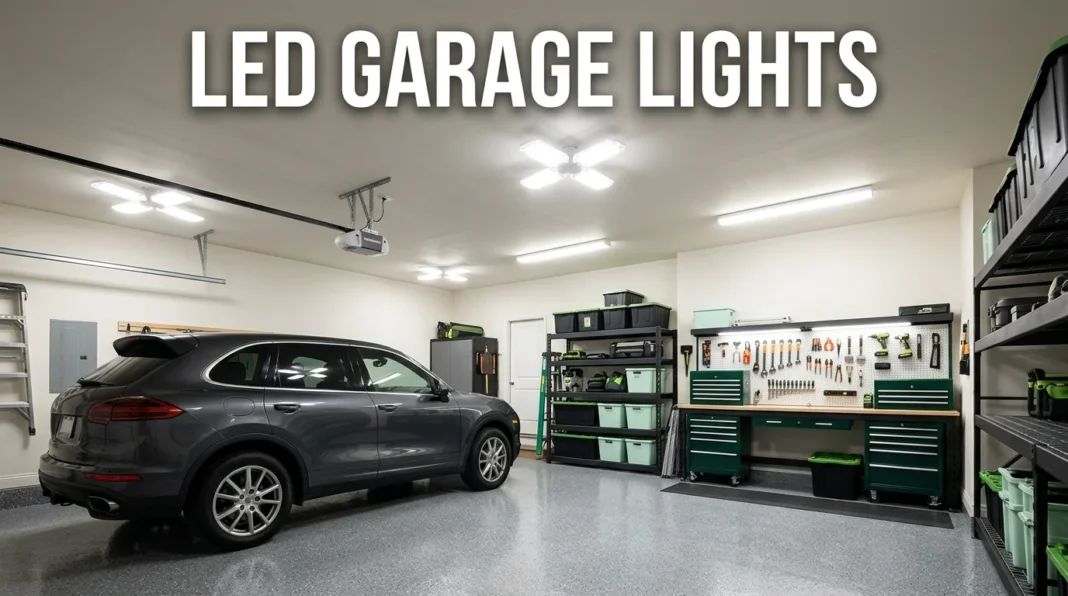
LED garage lights can turn a dim garage into a safer and more useful workspace. The right setup depends on brightness, layout, ceiling height, and your work. Choosing several well-positioned fixtures usually works better than relying on one extremely bright light.
Quick answer: For most residential garages, start with multiple 4-foot LED fixtures arranged across the ceiling for even coverage. Choose about 4000K to 5000K for clear task lighting, then add focused light above workbenches or detailed repair areas.
| Factor | Practical Starting Point |
|---|---|
| Fixture type | Linkable 4-foot LED shop lights for most garages |
| Color temperature | 4000K to 5000K for neutral-to-daylight white |
| General layout | Several evenly spaced fixtures instead of one central light |
| Detailed work | Add brighter task lighting above benches |
| Low ceilings | Flush or low-profile fixtures |
| Existing bulb socket | Adjustable screw-in panels can provide a fast upgrade |
| Taller garages | Consider higher-output fixtures designed for greater mounting heights |
| Useful features | Dimming, motion sensing, linkability, and replaceable controls |
Why Garage Lighting Needs More Than a High Lumen Number
Brightness matters, but total lumens don’t show how far the light reaches. A powerful central fixture can still leave shelves, corners, and work surfaces in shadow. Several fixtures can distribute light more evenly across the room.
Garages also contain reflective vehicles, metal tools, and glossy floors. Poor fixture placement can create glare while leaving darker areas hard to see. A balanced layout improves visibility without making the ceiling uncomfortable to look toward.
Published lighting guidance also shows why task areas need more illumination than storage spaces. Published IES guidance lists repair areas at 50–100 foot-candles. General garage areas need much less light than close mechanical work.
LED Garage Lights Compared by Fixture Type
Different fixtures solve different problems, so there is no universal winner. Your existing wiring and ceiling height narrow the choices quickly. The table below compares the most useful residential options.
| Fixture Type | Installation | Light Distribution | Best For | Main Drawback |
|---|---|---|---|---|
| 4-foot linkable shop lights | Easy to moderate | Wide and even | One-car and two-car garages | Requires several mounting points |
| Adjustable screw-in panels | Very easy | Directional | Fast socket upgrades | Can create glare |
| Wraparound fixtures | Moderate | Broad and diffused | Finished garages | Usually requires mounting work |
| Flat LED panels | Moderate | Wide and soft | Low ceilings | Higher initial cost |
| High-bay fixtures | Moderate to advanced | Strong downward output | Tall garages and workshops | Excessive for many residential garages |
1. Linkable LED Shop Lights
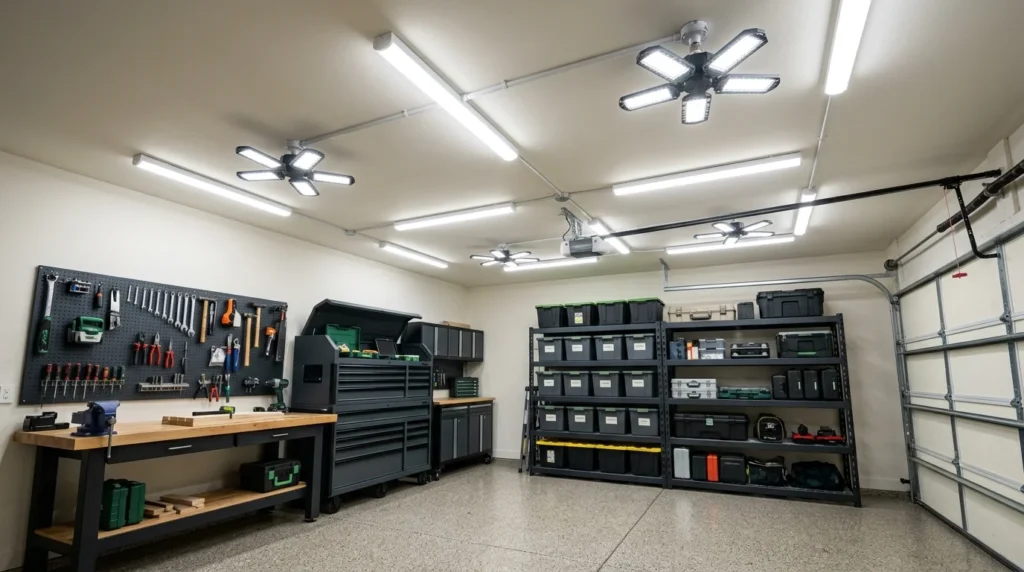
Four-foot LED shop lights are the strongest default choice for many home garages. Their long shape spreads light more evenly than a compact bulb fixture. Linkable models can also simplify a multi-fixture ceiling layout.
Pros.
- Even coverage across large areas
- Easy to position above vehicle bays
- Often available with plug-in linking
- Good choice for benches and general work
Cons.
- Several fixtures may be needed
- Cords can look messy without planning
- Mounting hardware varies by model
For most two-car garages, this type offers the best balance of coverage and flexibility. Current U.S. comparison pages also favor multiple 4-foot fixtures for broad residential use. The layout still matters more than chasing the largest advertised lumen figure.
2. Adjustable Screw-In Garage Lights
Adjustable panel lights screw into an existing standard bulb socket. Their hinged sections let you aim illumination toward walls, shelves, or work areas. They are useful when you want a fast improvement without installing several fixtures.
Pros.
- Fast installation
- No separate fixture wiring
- Adjustable beam direction
- Useful for rental or temporary spaces
Cons.
- Light remains concentrated around one socket
- Exposed panels can produce glare
- Very high claimed lumen ratings deserve careful scrutiny
These lights work best as convenient upgrades rather than full lighting plans. One unit may brighten the center while distant corners remain darker. Multiple ceiling locations are usually better for a larger working garage.
3. Wraparound and Flat-Panel Fixtures
Wraparound fixtures use a diffuser to soften and spread the light. Flat panels provide similarly broad illumination with a slim ceiling profile. Both styles suit garages that also function as finished hobby rooms.
Pros.
- Cleaner appearance
- Reduced direct glare
- Good coverage for low ceilings
- Suitable for multipurpose spaces
Cons.
- Installation can require electrical work
- Fixture replacement may cost more
- Some integrated models have nonreplaceable LEDs
These options make sense when comfort matters as much as maximum brightness. They also keep fixtures closer to low ceilings. A licensed electrician should handle new hardwired circuits when required.
4. High-Bay Garage Lighting
High-bay fixtures are designed to deliver useful light from higher mounting points. They are common in workshops, barns, and commercial spaces with tall ceilings. A typical eight-foot residential garage rarely needs this style.
Pros.
- Strong output from high mounting points
- Suitable for large workshop spaces
- Fewer fixtures may cover tall bays
Cons.
- Often excessive for standard garages
- Greater glare risk at lower heights
- Installation can be more involved
Choose high-bay fixtures because your ceiling requires them, not because their lumen number looks impressive. A lower ceiling benefits more from wider distribution. Correct mounting height helps turn raw output into useful illumination.
How to Choose LED Garage Lights for Your Space
Start by measuring the garage instead of shopping by wattage alone. Record the floor dimensions, ceiling height, and locations of existing electrical boxes, outlets, and bulb sockets. Mark benches, cabinets, tool areas, and where vehicles will sit.
Then divide the room into lighting zones. General ceiling lighting should evenly cover walking and parking areas. Workbenches, detailing areas, and machinery often need dedicated task lighting.
A simple paper sketch can prevent expensive placement mistakes. Draw each planned fixture and note nearby obstructions. Garage-door tracks and open doors can block ceiling-mounted light.
You can find more home project planning ideas in the Dream of DIY renovation section. The site also maintains a dedicated garage section for related projects. These resources can help you coordinate lighting with later improvements.
7 Buying Factors That Matter Most
1. Useful Brightness
Compare lumens rather than assuming higher wattage means more light. LEDs can produce different outputs from similar power consumption. Rely on dependable manufacturer documentation for published lumen figures.
Do not assume one enormous fixture solves every lighting problem. Even distribution makes a garage feel brighter at the same total output. Task zones can receive extra illumination where needed.
2. Color Temperature
Color temperature affects how warm or cool the garage appears. Around 4000K produces a neutral white appearance. Around 5000K creates a cooler daylight look that many people prefer for detailed work.
Extremely cool lighting can feel harsh in a small finished garage. Warmer light may feel comfortable but can reduce the crisp appearance some tasks benefit from. Adjustable-color fixtures provide flexibility when the garage serves several purposes.
3. Color Rendering
Color rendering describes how naturally colors appear beneath a light source. This matters when matching paint, inspecting wiring, detailing vehicles, or finishing woodworking projects. Look for a clearly stated CRI specification when color accuracy matters.
A high-output fixture can still make colors look poor. Brightness and color quality measure different characteristics. Evaluate both before choosing lighting for detailed projects.
4. Fixture Placement
Position fixtures beside work zones rather than directly behind you. Otherwise, your body can cast shadows across the surface you need to see. Lighting from multiple directions reduces this problem.
A two-row arrangement often works well in rectangular garages. Place additional task lighting directly above benches. Keep fixtures clear of garage-door movement and storage racks.
5. Glare Control
Exposed LEDs can be uncomfortable when mounted near eye level. Diffusers and wider fixtures soften the apparent brightness. Low ceilings make glare control especially important.
Adjustable panel fixtures should point toward useful surfaces instead of your normal sightline. Avoid aiming every panel straight downward without checking the result. Small angle changes can improve comfort without reducing useful light.
6. Controls and Sensors
Motion sensors are useful when you enter with groceries, tools, or both hands occupied. Dimmers can reduce unnecessary brightness during simple storage visits. Separate switching lets task areas operate independently.
Check compatibility before mixing dimmers with integrated LED fixtures. Manufacturers usually state whether a product supports dimming. Incorrect pairings can cause flickering or poor performance.
7. Safety and Installation
Choose fixtures carrying appropriate safety certifications for their intended use. Follow manufacturer instructions for mounting, linking, and electrical load. Never exceed the stated number of fixtures in a linked chain.
Simple plug-in fixtures can suit many DIY installations. New wiring and circuit changes require greater electrical knowledge. Dream of DIY’s light switch replacement guide explains important precautions for basic residential electrical work.
A Practical Layout for a Two-Car Garage
Imagine a two-car garage with an eight-to-nine-foot ceiling and one central bulb socket. Replacing only that bulb can improve brightness without fixing uneven coverage. The walls and workbench may still be poorly lit.
A stronger layout uses two parallel rows of long fixtures. Place the rows above the vehicle bays, keeping garage-door hardware clear. Add one separate fixture above the primary workbench.
This arrangement spreads light from several directions. It reduces deep shadows beneath open hoods and around shelving. It also lets you choose moderate fixtures instead of one extreme-output unit.
If the garage mainly stores vehicles, you may need less task lighting. A woodworking or automotive workspace benefits from brighter local illumination. Design around what happens inside the room.
Our Recommendation
For a standard U.S. home garage, linkable four-foot LED shop fixtures are the most practical starting point. They distribute light well and adapt easily to one-car or two-car layouts. Choose a reputable fixture with documented output and suitable safety certification.
Choose 4000K for a balanced, comfortable look. Choose 5000K when clear task visibility is the priority. Add diffused task lighting above benches instead of over-lighting the entire garage.
Adjustable screw-in lights remain useful for quick upgrades. They are especially convenient when new wiring is not practical. Still, several well-placed fixtures usually create better coverage.
Common Mistakes to Avoid
- Buying by watts instead of documented lumens
- Installing one bright fixture in the center
- Ignoring shadows from vehicles and your body
- Mounting lights where an open garage door blocks them
- Choosing 6500K without considering glare and comfort
- Trusting extreme lumen claims without checking specifications
- Forgetting task lighting above benches
- Linking more fixtures than the manufacturer permits
Frequently Asked Questions
How many LED garage lights do I need for a two-car garage?
There is no reliable answer based only on fixture count. Garage size, ceiling height, output, beam spread, and task requirements all matter. Several medium-output fixtures generally provide better coverage than one concentrated source.
Is 4000K or 5000K better for a garage?
Both can work well in a residential garage. Choose 4000K for a slightly softer neutral appearance. Choose 5000K when crisp task visibility matters more.
Are adjustable garage lights worth buying?
They can be useful when you already have ceiling bulb sockets. Adjustable panels help redirect illumination toward darker areas. They work less effectively when one socket must illuminate an entire large garage.
How bright should a garage workshop be?
A workshop requires more task illumination than simple vehicle storage. Published IES guidance tables place repair work at higher light levels than general garage use. Add focused bench lighting instead of increasing brightness everywhere.
Can I install garage lighting myself?
Plug-in and screw-in fixtures are often straightforward to install if you follow the directions. Hardwired fixtures require stronger electrical skills and may fall under local code requirements. Hire a qualified electrician when the project involves uncertain wiring or circuit changes.
Build the Lighting Plan Before You Buy
A good garage lighting upgrade starts with your room, not a product page. Map the ceiling, work areas, door tracks, outlets, and shadows before choosing fixtures. That simple step makes product comparisons much easier.
For most homes, several linkable fixtures provide the strongest balance of coverage and flexibility. Add targeted task lighting where detailed work happens. Visit the Dream of DIY garage projects for ideas on the rest of your workspace improvements.